Most beginners assume that improvement in pickleball only happens on the court. The reality is that some of the most important foundations paddle control, footwork, consistency, and serve mechanics can be built at home, without a net, a partner, or even a full court space.
We work with new pickleball players at Village Glen and South Towns Tennis and Pickleball regularly, and the players who improve fastest are almost never the ones with the most natural ability. They are the ones who practice with intention between sessions. This guide gives you a set of practical, beginner-friendly drills you can start today, at home, with minimal space and no special equipment beyond your paddle and a few balls.
Why Home Practice Accelerates Beginner Progress
Court time is limited. Lessons, clinics, and open play sessions are valuable, but they are rarely frequent enough on their own to build the muscle memory a beginner needs to feel genuinely comfortable with a paddle in their hand.
Home practice fills that gap. Even 15 to 20 minutes of focused solo drilling three to four times per week builds the hand-eye coordination, paddle feel, and footwork habits that make everything else easier when you step back onto the court. We have seen firsthand how players who commit to short, consistent home practice sessions progress at nearly double the rate of players who only show up to scheduled sessions.
What You Need Before You Start
Home drilling does not require much, but getting the basics right before you start matters. Using the wrong grip or the wrong paddle for your level during solo practice can reinforce bad habits rather than correct them.
Before beginning any drill routine, confirm these three things:
- Your grip is correct hold the paddle with a relaxed Continental grip, similar to shaking hands with the handle, with no squeezing or white-knuckle tension
- Your paddle weight is appropriate for your current level beginners perform best with paddles in the 7 to 7.9 ounce range that allow easy manoeuvrability
- You have at least three to five pickleballs available so you can move through drills without constantly stopping to retrieve a single ball
With these three things in place, every drill in this guide will produce cleaner, more useful results from the very first session.
Drill 1: The Wall Rally
What it builds: Paddle control, reaction time, and consistent contact
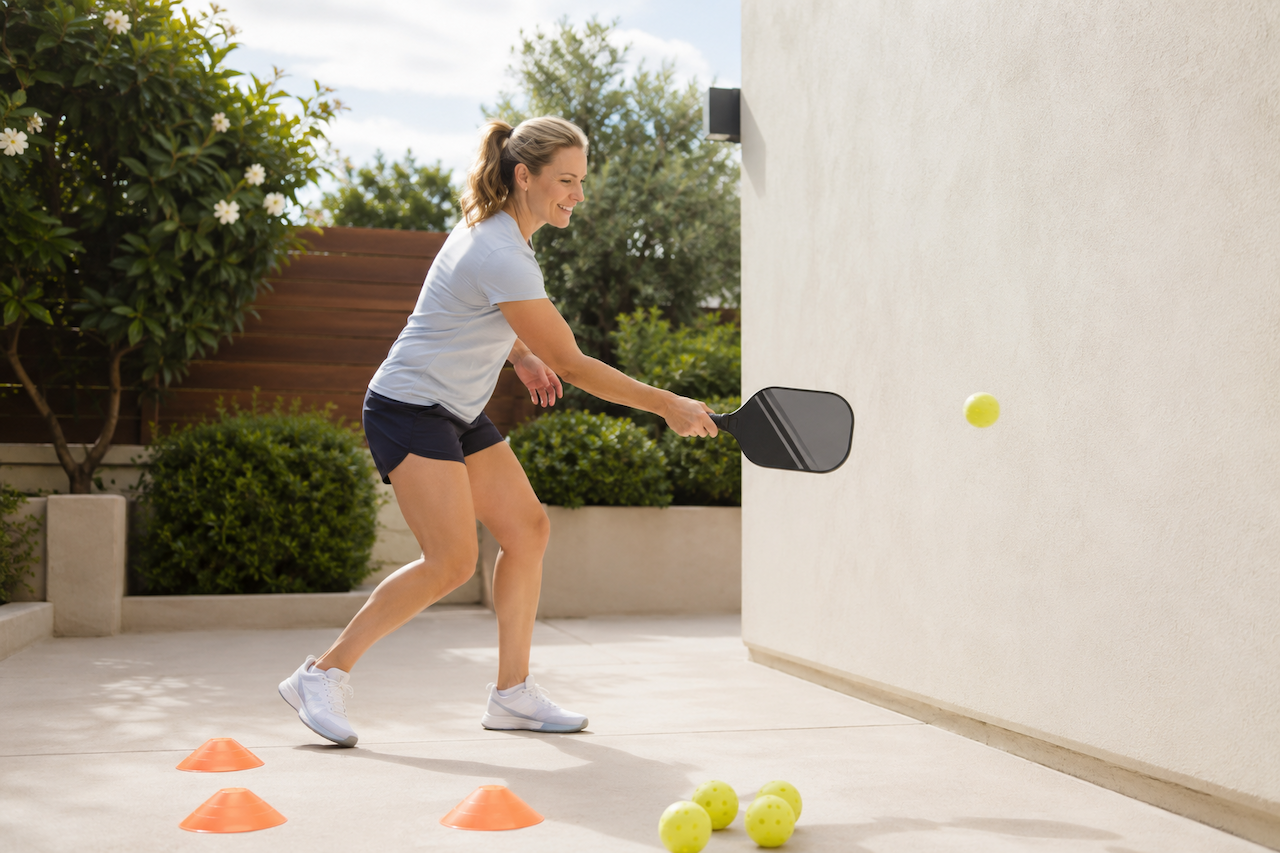
The wall rally is the single most effective solo drill for beginner pickleball players. All you need is a flat wall, a paddle, and one ball. Stand approximately five to seven feet from the wall and hit the ball gently against it, allowing it to bounce once before hitting it again. Your goal is not power it is control. Keep the ball coming back to the same spot on the wall on every hit.
Start with your forehand only for the first two minutes, then switch to your backhand for the next two minutes. Once both feel stable, alternate forehand and backhand on consecutive hits. This forces you to adjust your grip and paddle angle quickly, which directly replicates the fast exchanges that happen at the kitchen line during real play.
We always advise beginners to resist the urge to hit harder as they get more comfortable. The wall rally drill builds value through repetition at a controlled pace, not through speed.
Drill 2: The Dink Drop Drill
What it builds: Soft touch, kitchen line control, and paddle face angle
The dink is one of the most important shots in pickleball and one of the hardest for beginners to develop because it requires restraint rather than power. This drill isolates touch in a simple home setting.
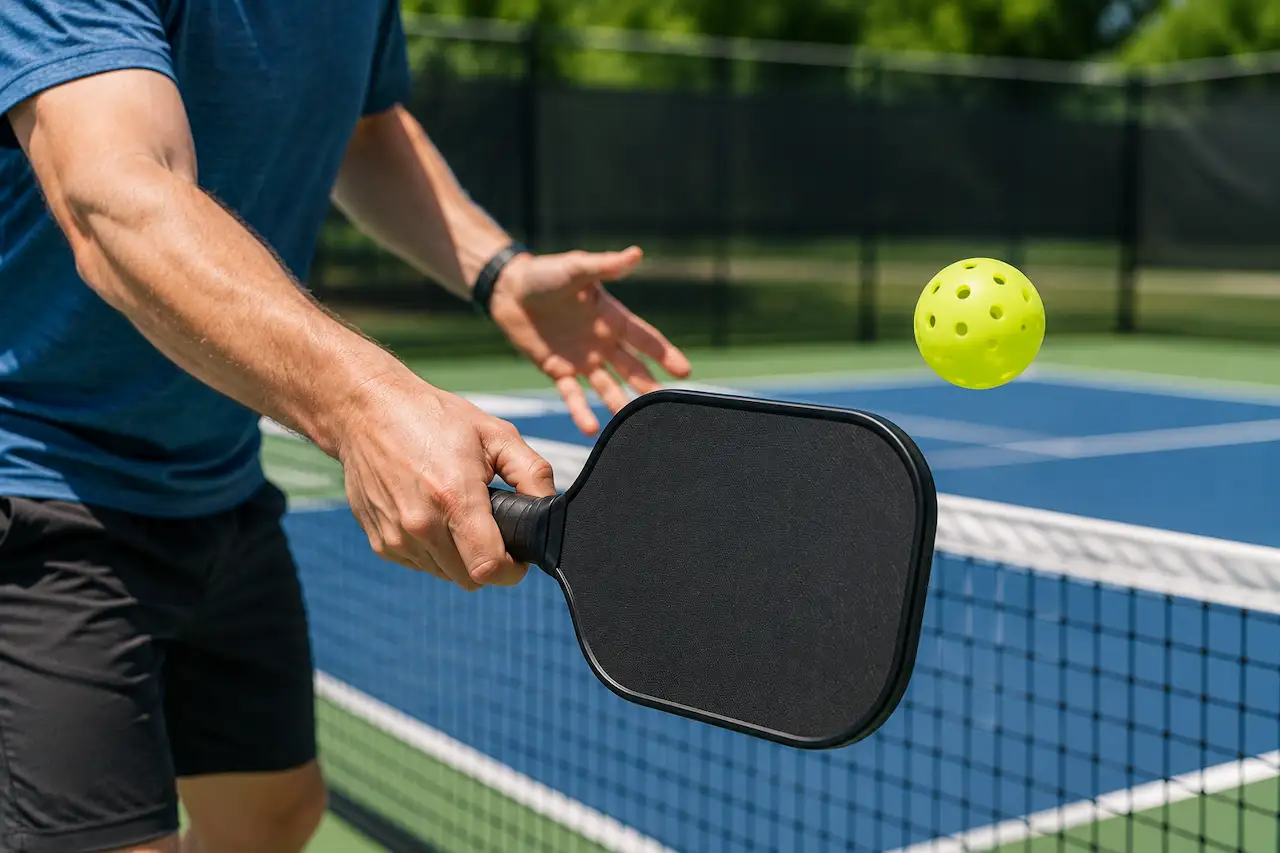
Stand in your living room or any open space and hold the paddle in front of you at waist height. Drop the ball from your non-paddle hand and let it bounce once, then gently tap it upward with the paddle face just high enough to clear an imaginary net. The goal is to keep the ball bouncing softly in front of you using only small, controlled paddle movements with almost no backswing.
Repeat this 20 to 30 times per session. This drill teaches your wrist and forearm to produce soft, accurate contact a skill that cannot be developed by hitting hard and hoping for the best.
Drill 3: Footwork Ladder Patterns
What it builds: Court movement, split step timing, and balance at contact
Footwork is the part of pickleball that beginners neglect most consistently, and it is the reason many players hit technically sound shots from a stationary position but struggle the moment they have to move before hitting. Good footwork means arriving at the ball in a balanced, ready position not reaching for it or falling into it.
You do not need an agility ladder to build better footwork at home. Use tape or chalk on a hard floor to mark out a simple pattern of boxes and practice these three movements daily:
- Side shuffle: Move laterally two steps to the right, then two steps to the left, staying low with your knees bent and your weight on the balls of your feet
- Split step and recover: Take a small hop to land on both feet simultaneously, hold your balance for one second, then shuffle back to the center position
- Forward and back: Step forward two paces, then back two paces, keeping your paddle up and ready throughout the entire movement
Each of these patterns directly mirrors a movement you will make during a real pickleball point. Ten minutes of footwork practice at home produces results that hours of slow-footed court play cannot.
Drill 4: Serve Toss and Contact Drill
What it builds: Serve consistency, ball placement, and contact mechanics
The serve is the one shot in pickleball where you have complete control over the starting conditions. A consistent serve gives you an immediate advantage at the beginning of every point, yet most beginners rush through it without any structured practice.
This drill focuses on the two most common beginner serve mistakes an inconsistent toss and incorrect contact height. Stand in your serving position with your paddle ready. Practice your toss alone first, without swinging, until the ball lands in the same spot in front of your body every single time. Once the toss is reliable, add the swing and focus on making contact below waist height with a smooth upward motion, not a downward chop.
Our pickleball lessons at South Towns cover serve mechanics in detail alongside structured feedback, which accelerates this drill’s results significantly when combined with home practice.
Drill 5: Target Bounce Drill
What it builds: Shot placement, paddle face control, and directional accuracy
Hitting the ball is one skill. Hitting it where you intend to is another. This drill builds the second skill, which is the one that actually wins points.
Place a small target on the floor a piece of tape, a towel, or a cone and stand five to six feet away. Using a soft, controlled forehand or backhand motion, bounce the ball off your paddle and aim for the target on each bounce. Start with a stationary target and progress to moving the target after every five successful hits so you are constantly adjusting your aim.
The target bounce drill trains your brain and your paddle hand to work together, which is exactly what consistent shot placement in a real game requires.
How to Build These Drills Into a Weekly Routine
Individual drills produce results, but a structured weekly routine produces lasting improvement. We prioritize a strategy of building short, focused practice sessions rather than long, unfocused ones.
Here is a practical home practice schedule for beginners:
- Monday and Thursday: Wall rally drill 10 minutes forehand, 10 minutes backhand, 5 minutes alternating
- Tuesday and Friday: Dink drop drill 3 sets of 30 repetitions, followed by 10 minutes of footwork ladder patterns
- Wednesday: Serve toss and contact drill 20 toss-only repetitions, then 30 full serve swings focusing on contact height
- Weekend: Target bounce drill as a warmup before any court session or open play
This routine takes under 30 minutes per session and covers every fundamental skill a beginner needs to build before moving into more advanced clinic work.
Once your home practice feels consistent, joining our beginner pickleball clinics at Village Glen gives you the structured coaching and live feedback environment that takes these home-built foundations to the next level.
A Real-World Example: Home Practice That Changed a Player’s Game
We worked with a beginner pickleball player at Village Glen who was attending open play sessions twice a week but felt like she was not improving despite the court time. Her dinking was inconsistent, her serves kept landing long, and she felt rushed by faster opponents during exchanges.
After one session with our coaching staff, we identified that her paddle face angle was closing slightly at contact on both her dink and her serve a mechanical issue that was impossible to self-diagnose without feedback. We gave her the dink drop drill and the serve toss drill to practice at home specifically targeting paddle face awareness.
Within three weeks of daily home practice combined with her regular pickleball open play sessions, her dinking consistency improved significantly and her serve began landing in the correct zone on the first attempt far more reliably. The court time had always been there the targeted home practice was what gave it direction.
Conclusion
Pickleball drills for beginners do not require a court, a partner, or expensive equipment. They require intention, consistency, and a clear understanding of what each drill is actually building. The five drills in this guide cover every core foundation a new player needs paddle control, soft touch, footwork, serve mechanics, and shot placement. Practice them consistently at home and your court sessions will immediately feel more productive and more confident. At Village Glen and South Towns Tennis and Pickleball, we are here to support that progress every step of the way.
Why Choose Us
At Village Glen and South Towns Tennis and Pickleball, we help beginner pickleball players build real foundations through structured coaching, supportive clinic environments, and expert guidance from day one.
- Two full-service club locations in Williamsville and Orchard Park, with beginner pickleball programs available at both clubs
- Certified pickleball coaches who identify mechanical issues early and provide targeted corrections before bad habits develop
- Structured beginner clinics that build on exactly the foundations covered in home practice routines
- Open play sessions available throughout the week, giving beginners consistent court time in a welcoming environment
- A clear progression path from beginner clinics through to intermediate and competitive levels, so players always know their next step
Frequently Asked Questions
How much space do I need to practice pickleball drills at home?
Most of the drills in this guide require very little space. The wall rally drill needs a clear wall and approximately six to eight feet of space in front of it. The dink drop drill, footwork patterns, and target bounce drill can all be done comfortably in a living room or garage. You do not need a full court or even an outdoor space to build meaningful paddle and footwork skills at home.
How often should a beginner practice pickleball at home?
We recommend three to four short sessions per week of 20 to 30 minutes each, rather than one long session. Frequent, shorter practice builds muscle memory far more effectively than occasional long sessions because the body needs repetition spaced over time to store new movement patterns reliably. Consistency matters more than duration at the beginner stage.
Can home drills replace court time and coaching?
Home drills build the foundations that make court time and coaching more productive; they do not replace them. Drills train isolated skills in a controlled environment, but real improvement also requires live feedback from a coach and the pressure of actual play against opponents. The most effective approach combines regular home practice with structured clinic sessions and open play.
What is the most important pickleball skill for a beginner to focus on first?
Paddle control and the dink are the two areas we recommend beginners prioritize above everything else. A reliable dink keeps you in rallies and prevents easy put-aways by your opponents. Paddle control underpins every other shot in the game. Once those two foundations are solid, serve consistency and footwork become the next natural focus areas.
When should a beginner move from home practice to structured coaching?
The right time to add structured coaching is as soon as possible ideally from the very beginning. Home practice builds repetition, but it cannot tell you whether you are repeating the right mechanics. A coach identifies errors that are invisible to the player and provides corrections before they become ingrained. We recommend starting with at least one clinic or lesson session alongside your home practice from the first week.