
Your serve is the only shot in tennis where you are in complete control. No opponent, no bounce, no reaction time just you, the ball, and the court. Yet it remains the most misunderstood and most poorly practiced part of the game for the majority of players.
We have worked with hundreds of players at Village Glen and South Towns Tennis and Pickleball in Western New York, and the serve is consistently where we see the most fixable errors. The good news is that most serving mistakes follow a clear, repeatable pattern and once you understand them, the corrections are direct and lasting.
Why Your Tennis Serve Breaks Down Before You Even Swing
Most players assume their serve problems start at the point of contact. In reality, the breakdown usually happens long before the racket ever meets the ball. Stance, grip, and preparation are the foundation of every effective serve, and when those three elements are off, no amount of swing adjustment will fix the result.
We always advise players to film their serve from the side and from behind before making any change. What you feel during a serve and what is actually happening are rarely the same thing. A player who believes they are tossing the ball straight up is often sending it forward or to the left by 12 to 18 inches enough to completely change the swing path and contact point.
The serve is a kinetic chain. Every segment of your body from your feet to your shoulder to your wrist must work in sequence. When one link breaks, the entire chain loses power, accuracy, or both.
The Most Common Tennis Serve Mistakes and How to Fix Them
This is where we focus most of our coaching energy, because recognizing the mistake is half the solution. Before we break each one down, here is a quick overview of the four mistakes we correct most often across both clubs:
- An inconsistent or misplaced ball toss that changes your contact point on every serve
- Using the wrong grip, which limits wrist pronation and removes natural power from the swing
- Flat feet and no leg drive, taking away the engine that generates real serve speed
- Swinging at the ball rather than through it, which produces short and floating serves
Mistake 1: An Inconsistent Ball Toss
The ball toss is the single most important variable in a reliable serve, yet it is the most neglected in practice. Players rush the toss, place it too far in front, or produce a different height on every attempt. The result is a serve that feels different on every repetition because it genuinely is different.
The fix requires dedicated repetition away from full serving. Practice your toss as a standalone drill with no swing at all. Stand in your serving position, toss the ball, and let it land on the court. Your target landing zone for a flat serve should be roughly one to two feet in front of your front foot and slightly to the racket side of your body. Repeat this 20 times before hitting a single serve in any practice session.
Mistake 2: Gripping the Racket Like a Forehand
A large number of recreational players use a forehand or Eastern grip on their serve. This grip limits wrist pronation and removes the natural snap that generates both power and spin. It also forces a flat, push-through motion that is extremely difficult to control under pressure.
The correct grip for most serve types is the Continental grip, where the base knuckle of your index finger sits on bevel two of the racket handle. It feels unfamiliar at first, but it unlocks the full range of motion your wrist and forearm need. We prioritize a strategy of drilling the grip in isolation shadow swings only, no ball until the movement becomes automatic and comfortable.
Mistake 3: No Leg Drive or Trophy Position
Players who serve with flat feet give up 30 to 40 percent of their potential serve speed before the swing even begins. The legs are the engine of the serve. Bending your knees during the loading phase and driving upward through contact transfers ground force through your body and into the ball.
The trophy position where your non-dominant arm is extended upward with the toss and your racket arm is bent at roughly 90 degrees behind your head is the checkpoint that confirms whether your timing and coil are correct. If you cannot hold a clean trophy position during slow-motion practice, your serve will remain inconsistent under match pressure.
Mistake 4: Swinging at the Ball Instead of Through It
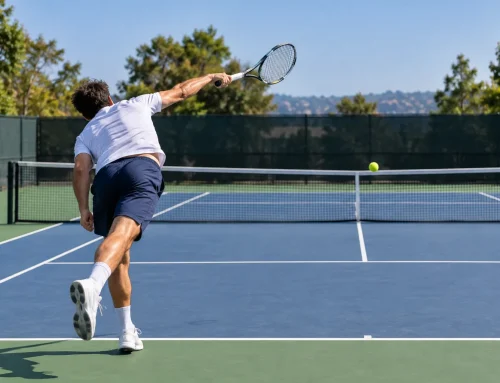
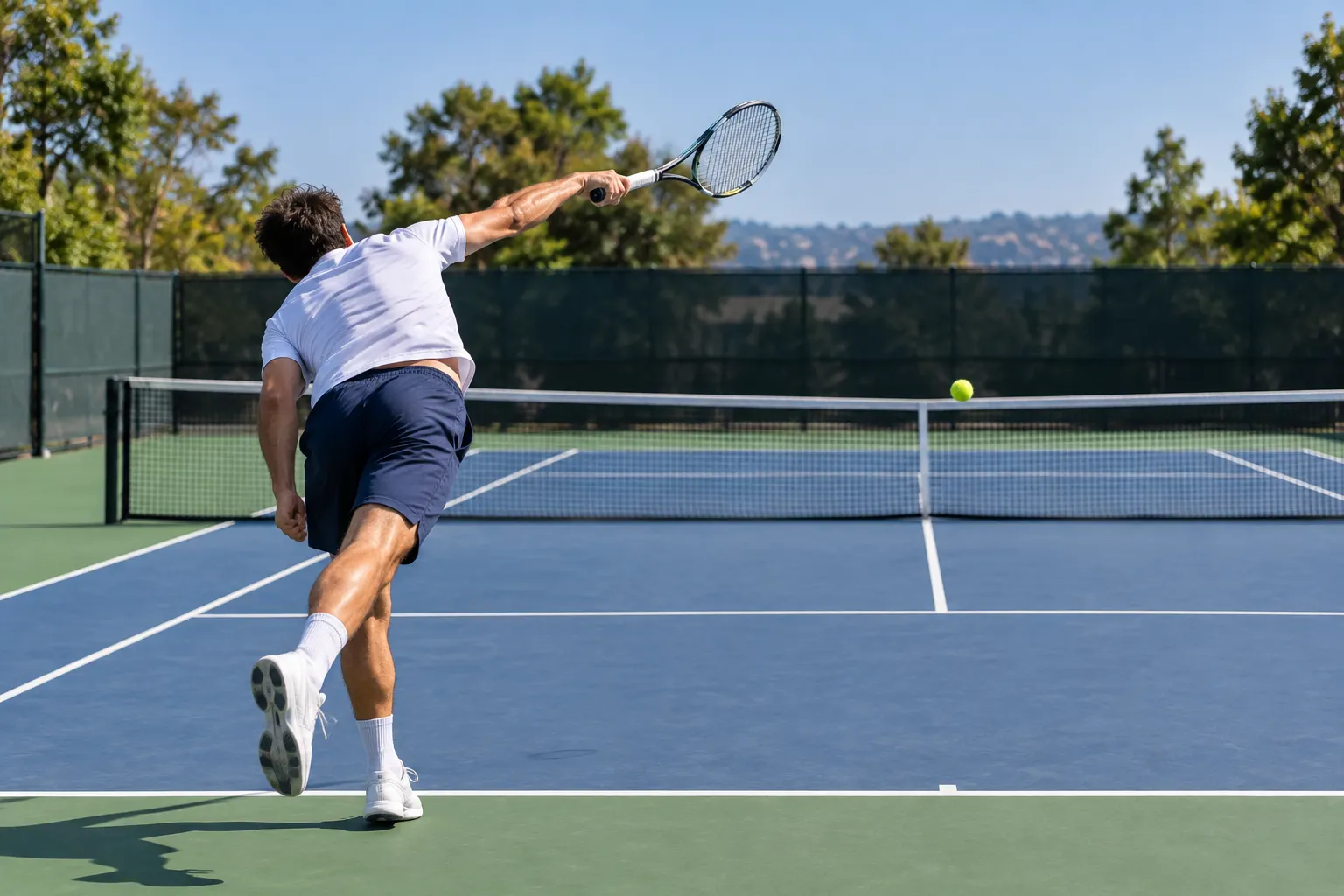
Many players treat the serve like a slap or a push. They aim to make contact with the ball and stop there. A technically sound serve involves swinging through the contact point and finishing with the racket crossing the body down toward the opposite hip. This follow-through is not decorative; it is what produces spin, depth, and control at the same time.
If your serves are landing short or floating into the net on the second ball, a shortened follow-through is almost always part of the cause.
Flat Serve vs Topspin Serve: Choosing the Right Tool
One of the most practical decisions a developing player makes is when to use a flat serve versus a topspin serve. We have seen firsthand that players who rely only on a flat first serve with no reliable second serve option lose confidence quickly in match situations because the margin for error is so thin.
A flat serve is hit with minimal spin and travels fast and low through the court. It is most effective as a first serve when you want pace and directness. A topspin serve uses heavy brushing upward through the ball to create a higher bounce and more net clearance. It is the preferred second serve for intermediate and advanced players because it provides a meaningful safety margin while still putting pressure on the returner.
The right approach is to develop both. Use the clinics and match play sessions at Village Glen and South Towns to practice each serve type in a competitive setting where real-point pressure sharpens your decision-making faster than solo drilling alone.
A Real-World Example: From Double Faults to Match Confidence
One of the most consistent patterns we observe at our clubs involves intermediate players who are double-faulting five to eight times per match. They arrive frustrated, often believing their second serve is simply not reliable enough. In almost every case, the root issue is not the second serve itself it is the first serve.
When a player’s first serve percentage drops below 45 percent, they begin to second-guess the second ball before they even hit it. The mental hesitation leads to a shortened swing, which produces less spin, less net clearance, and a higher fault rate. It becomes a cycle that compounds under competitive pressure.
The fix we apply starts with rebuilding first serve consistency. We narrow the target zone, reduce swing speed by 20 percent, and focus on clean contact before adding pace back in. Within four to six weeks of structured practice through our adult development programs, players routinely move from 40 percent to 65 percent first serve percentages. That single change transforms how they approach the second serve entirely.
Three Drills That Reinforce Correct Serve Technique
Practice without structure produces inconsistency. These three drills target the most common technical errors directly and can be used before every session to build reliable muscle memory:
- The Toss and Catch Drill: Stand in your service stance, toss the ball to your ideal contact point, and catch it with your non-dominant hand at full arm extension. Repeat until the toss lands in the same zone every single time without adjustment.
- The Fence Drill: Stand approximately two feet behind the baseline and serve into the fence using only your arm and wrist snap, no leg drive. This isolates the pronation and contact mechanics and immediately reveals whether your grip and swing path are working correctly.
- The Box Serve Drill: Place a cone or marker in a specific zone within the service court wide, body, or down the T and serve 10 balls at that single target before moving to the next. This builds accuracy under repetition and transfers directly into match situations.
Booking private tennis lessons with one of our certified professionals gives you direct, real-time feedback on all three drills so corrections happen faster and hold longer.
How Coaching Accelerates Your Serve Improvement
Self-correcting a tennis serve is genuinely difficult. The motion happens in under one second from toss to contact, and your body cannot process what went wrong in real time without an outside perspective. This is exactly where professional coaching creates a measurable difference.
At Village Glen and South Towns Tennis and Pickleball, our certified instructors use structured feedback and progressive drill sequences to identify exactly which part of the kinetic chain is breaking down for each individual player. We do not use a one-size-fits-all correction plan because no two players arrive with the same set of habits or the same movement patterns.
Players who combine structured drills with consistent tennis lessons at South Towns improve their serve reliability within 30 days. That is not a general claim; it is a pattern we observe across all skill levels, from beginners working on their first clean flat serve to competitive players refining a second-serve kick under pressure.
If you are a junior player, our junior development programs introduce correct serve mechanics from the very beginning so damaging habits never have the chance to form.
Conclusion
The serve is a learnable skill, not a natural talent. Every mistake covered in this article has a clear, proven correction and none of them require starting from zero. Grip, toss, leg drive, and follow-through are the four pillars. Fix those four elements in sequence and your serve will become a consistent, confident weapon rather than a liability on every second ball. At Village Glen and South Towns Tennis and Pickleball, we have the courts, the coaching staff, and the structured programs to make that improvement happen faster than you can on your own.
Why Choose Us
At Village Glen and South Towns Tennis and Pickleball, we combine professional coaching, well-maintained courts, and year-round programs to help every player build a stronger, more consistent game.
- Two full-service club locations in Williamsville and Orchard Park, with both hard and clay courts available at Village Glen
- Certified tennis professionals who deliver individualized correction plans built around your specific movement patterns and habits
- Adult, junior, beginner, and advanced programs running year-round, including a full indoor season schedule
- Private lessons, group clinics, and match play sessions available across both clubs to fit your schedule and goals
- A supportive community environment where players at every level improve consistently and enjoy the process
Frequently Asked Questions
How many lessons does it take to fix a tennis serve?
Most players see meaningful improvement in their serve technique within four to eight private lessons when combined with structured practice between sessions. The timeline depends on how deeply ingrained the current habits are and how consistently the player drills outside of lesson time. We always build a personalized correction sequence so progress is steady and measurable from the very first session.
Should beginners learn a flat serve or a topspin serve first?
We recommend beginners start with a flat or slice serve because the swing path is more intuitive and the contact point is easier to locate consistently. Once a player has a reliable first serve with a clean toss and correct grip, we introduce topspin mechanics as the natural next step. Attempting to learn kick serve mechanics before the fundamentals are in place creates confusion and slows overall progress significantly.
What is the correct grip for a tennis serve?
The Continental grip is the standard for all serve types at the intermediate to advanced level. It positions the racket face correctly at contact, allows full wrist pronation through the swing, and supports both flat and topspin serve variations without adjustment. We address grip correction in the first session with every new student because it directly affects every other part of the serve chain.
Why do I keep double faulting on the second serve?
Double faults on the second serve are almost always caused by a grip issue, a shortened follow-through under pressure, or a first serve percentage so low that the player is already mentally defensive before the second ball is hit. We address all three in our private lesson and adult clinic programs and prioritize rebuilding first serve confidence before adjusting second serve mechanics.
Can I improve my serve without taking private lessons?
You can make some progress through structured self-practice using drills like the toss and catch or the fence drill, but the ceiling is lower without an external perspective. The serve happens too quickly for most players to accurately self-diagnose what is going wrong on each attempt. A single lesson with direct feedback often reveals two or three specific errors the player had no awareness of and accelerates improvement significantly compared to solo practice alone.