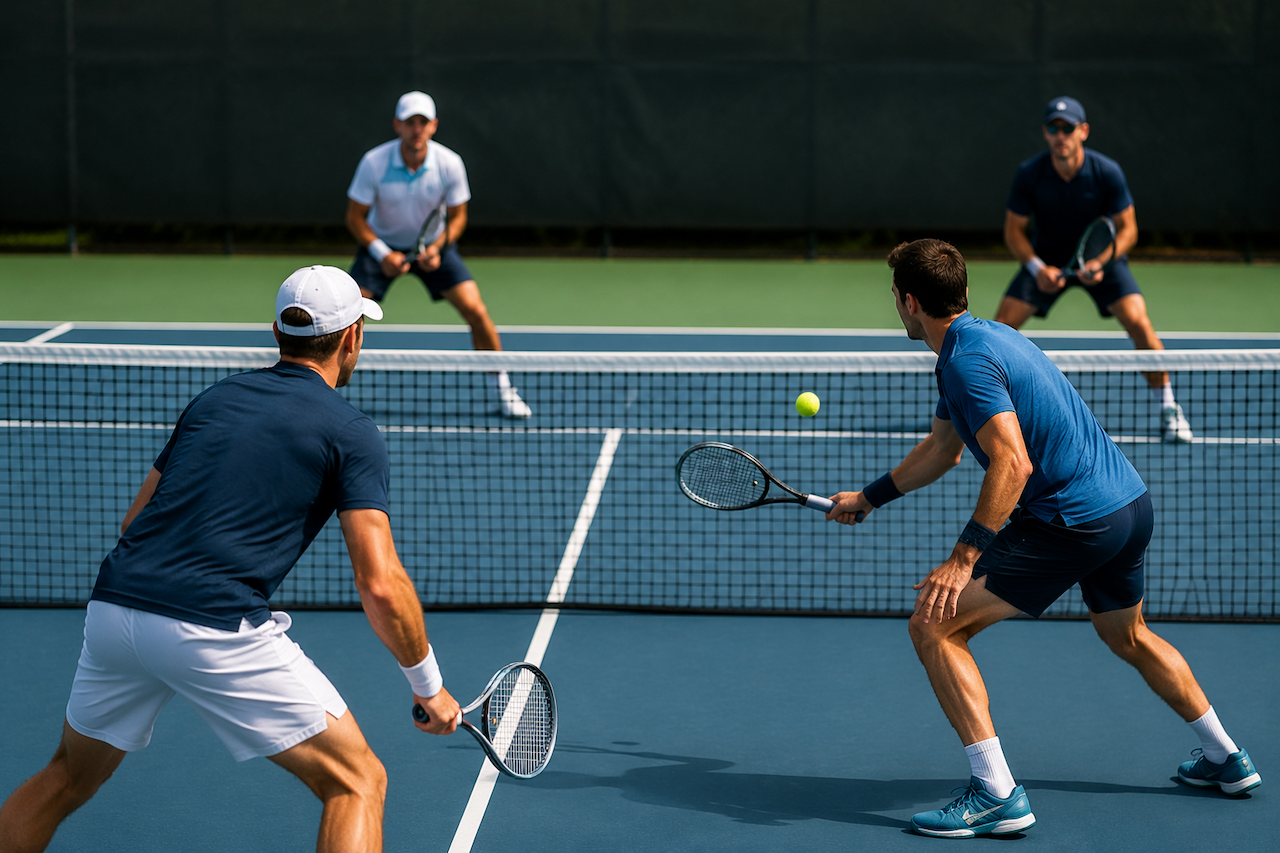
Doubles tennis at a competitive level is a completely different game from singles. Court coverage is shared, but decision-making speed, communication, and positioning become far more demanding. A player with a strong individual game can still lose consistently in doubles if their strategic understanding does not match their physical skill.
We work with competitive doubles players at Village Glen and South Towns Tennis and Pickleball every week, and the pattern is consistent. The teams that win are not always the most athletic; they are the ones who understand court geography, anticipate patterns, and communicate before the point even starts. This guide breaks down the strategies we teach our competitive players to take their doubles game to the next level.
Why Doubles Strategy Matters More Than Raw Skill
Singles tennis rewards individual shot-making and physical endurance. Doubles rewards anticipation, positioning, and split-second decisions made in coordination with a partner. A player who hits a powerful forehand but stands in the wrong position after the shot gives their opponents an easy target. A team that communicates clearly before every point closes gaps that strong shot-makers cannot close alone.
We always advise competitive players to think of doubles as a chess match played at speed. Every position you take on the court either creates pressure on your opponents or creates a gap they can exploit. The strategies in this guide are built around removing those gaps and creating that pressure consistently.
Core Positioning Principles for Competitive Doubles
Before getting into specific formations, every competitive doubles player needs to understand three positioning principles that apply across nearly all situations.
- Always move as a unit, not as two separate players, so your team never has both players pulled out of position at the same time
- The net player should constantly adjust position based on where the ball is being hit, not stay fixed in one spot
- Court coverage responsibility shifts the moment either player moves forward or back, and your partner must recognize and respond to that shift immediately
These three principles form the foundation for every formation and tactic that follows. A team that moves together and reads these shifts in real time will consistently out-position teams with stronger individual shots. Building this kind of court awareness is one of the first things we focus on in our adult development programs.
The Standard Formation and When to Break From It
The standard doubles formation places one player at the net and one player at the baseline, with both players covering their respective half of the court. This formation works well as a default but becomes predictable against strong competitive opponents who learn to exploit the gap down the middle.
The I Formation
The I formation is used primarily on serve. Both players on the serving team start in the center of the court along the service line, creating uncertainty for the returner about which direction each player will move after the serve. This formation disrupts a returner’s ability to target a predictable gap and is especially effective against opponents with a strong cross court return.
The Australian Formation
In the Australian formation, the server and their net partner both position themselves on the same side of the court, rather than the standard setup where the net player covers the opposite side from the server. This formation removes the returner’s easiest cross court angle and forces them to hit down the line, which is a lower-percentage shot for most players. We prioritize teaching this formation to teams whose opponents consistently exploit the cross court return against a standard setup.
Switching between standard, I formation, and Australian formation throughout a match keeps opponents guessing and prevents them from settling into a comfortable return pattern.
Poaching: The Tactic That Wins Points Before They Start
Poaching is when the net player moves across to intercept a shot that would normally go to their partner. Done well, it is one of the most effective tactics in competitive doubles because it ends points quickly and creates psychological pressure that affects the opposing team for the rest of the match.
The mistake we see most often with developing doubles players is hesitation. A poach only works if it is committed to fully and early. A half-hearted poach leaves both players out of position and the gap becomes wide open. We always tell our competitive players the same thing: if you decide to poach, go all the way and trust your partner to cover the space you left behind.
Effective poaching requires three things working together. First, reading your opponent’s body position and racquet preparation to anticipate shot direction before contact. Second, clear communication with your partner so they know to shift and cover immediately. Third, timing the move late enough that the returner cannot adjust, but early enough to reach the ball cleanly.
Communication Systems for Competitive Teams
At a competitive level, verbal and signal-based communication between points becomes a genuine strategic advantage. Teams that communicate clearly win more close matches than teams relying purely on individual instinct.
A common system used in competitive doubles is hand signals given by the net player behind their back before the serve, indicating to their partner whether they plan to stay, poach, or fake a poach. This lets the server adjust their serve placement to support the plan and removes the guesswork that causes miscommunication during fast exchanges.
We have seen firsthand how much difference this single habit makes. Teams that adopt a simple signal system before every serve consistently reduce unforced errors caused by both players covering the same space or leaving the same gap open. This is one of the first habits we build with players joining our clinics and match play sessions at Village Glen.
A Real-World Example: Turning a Losing Pattern Into a Winning One
We worked with a competitive doubles team at Village Glen who were consistently losing close three-set matches against teams they were technically more skilled than. After reviewing match footage with them, the pattern was clear. Their opponents were repeatedly targeting the gap down the middle on the return, and neither player was adjusting their position to close it.
The fix did not require new shots or more physical conditioning. We worked with the team on recognizing when to shift into the I formation on serve and on building a basic poach signal system between points. Within two months of practicing this through our match play sessions at South Towns, the same team began winning matches against opponents they had previously lost to twice that season.
The lesson from this example applies broadly. Strategic adjustments often produce faster results than additional hours of physical training, especially for teams whose individual skill level is already solid.
Building These Strategies Into Your Game
Reading about doubles strategy is useful, but these tactics only become reliable under real match pressure when they are practiced repeatedly with a consistent partner. Formation changes, poaching timing, and communication signals all require live repetition to become automatic.
If you are preparing for an upcoming tournament, working these formations and signals into your practice routine ahead of time ensures your team is not learning new tactics under competitive pressure for the first time. Our tournaments and events program gives competitive teams a real opportunity to apply these strategies in genuine match conditions, with direct feedback from our coaching staff after each set.
Conclusion
Competitive doubles success comes down to positioning discipline, committed poaching, and clear communication between partners. None of these strategies require additional athletic ability they require understanding and repetition. Teams that master the I formation, the Australian formation, and a reliable signal system consistently outperform teams relying on individual skill alone. At Village Glen and South Towns Tennis and Pickleball, we help competitive players build these habits into a system that holds up under real match pressure.
Why Choose Us
At Village Glen and South Towns Tennis and Pickleball, we give competitive doubles players the coaching, match play environment, and structured programs needed to turn strategy into consistent results on court.
- Two full-service club locations in Williamsville and Orchard Park, with dedicated competitive match play sessions at both clubs
- Certified coaches who use match footage and live feedback to correct positioning and decision-making in real time
- Structured adult development programs that build doubles strategy alongside technical skill development
- Regular tournaments and events that give competitive teams the chance to apply strategy under genuine match pressure
- A strong community of competitive players across Western New York who push each other to improve consistently
Frequently Asked Questions
What is the best doubles formation for beginners moving into competitive play?
The standard formation with one player at the net and one at the baseline is the right starting point because it teaches basic court coverage and positioning discipline. Once a team is comfortable with standard positioning and communicates well, we introduce the I formation and Australian formation to add variety and disrupt opponent patterns.
How do I know when to poach in doubles?
The best poaching opportunities come from reading your opponent’s racquet preparation and body position before contact, not reacting after the ball is already hit. A weak or late shot preparation from the returner is usually a clear signal to commit to a poach.
Why does my doubles team keep losing close matches despite being more skilled?
This is one of the most common patterns we see, and it almost always comes down to positioning gaps and communication breakdowns rather than a lack of skill. Teams that are technically strong but strategically unprepared consistently lose to less skilled teams who communicate clearly and cover the court as a unit.
Do I need a regular doubles partner to improve my strategic game?
A consistent partner accelerates progress significantly because timing, signals, and trust develop through repetition together. That said, players without a regular partner can still build strong strategic foundations through our match play sessions, where they play with different partners and develop adaptability, which is also a valuable competitive skill.
How long does it take to see results from working on doubles strategy?
Most competitive teams notice a measurable difference within four to six weeks of consistent practice, particularly around formation changes and communication systems. Poaching timing and full strategic fluency under match pressure typically develop over a longer period of three to four months of regular match play.