Joining a tennis or pickleball club is not just a decision about court access. It is a decision about the kind of environment you want to be part of the people you will practice alongside, the relationships that build over years of shared competition, and the sense of belonging that comes from being part of a community with a shared passion.
At Village Glen and South Towns Tennis and Pickleball in Western New York, social events are not an add-on to the club experience. They are a core part of what makes membership genuinely valuable beyond the courts. This article explores why tennis club social events matter, what they produce for individual members, and how they build the kind of community that keeps players coming back year after year.
Why the Social Side of a Tennis Club Matters More Than Most Players Expect
Most people join a tennis or pickleball club for practical reasons court access, coaching programs, and the opportunity to improve their game. The social dimension is rarely the primary motivation. Yet in nearly every case, it becomes one of the most valued parts of the membership experience within the first season.
We have seen firsthand how members who initially joined purely to improve their tennis or pickleball game gradually find that the friendships, the conversations between matches, and the shared experiences around club events become as meaningful as the sport itself. A club that invests in its social culture retains members longer, produces a more supportive competitive environment, and creates a space where players of all ages and levels feel genuinely welcome rather than simply accommodated.
What Tennis Club Social Events Actually Look Like
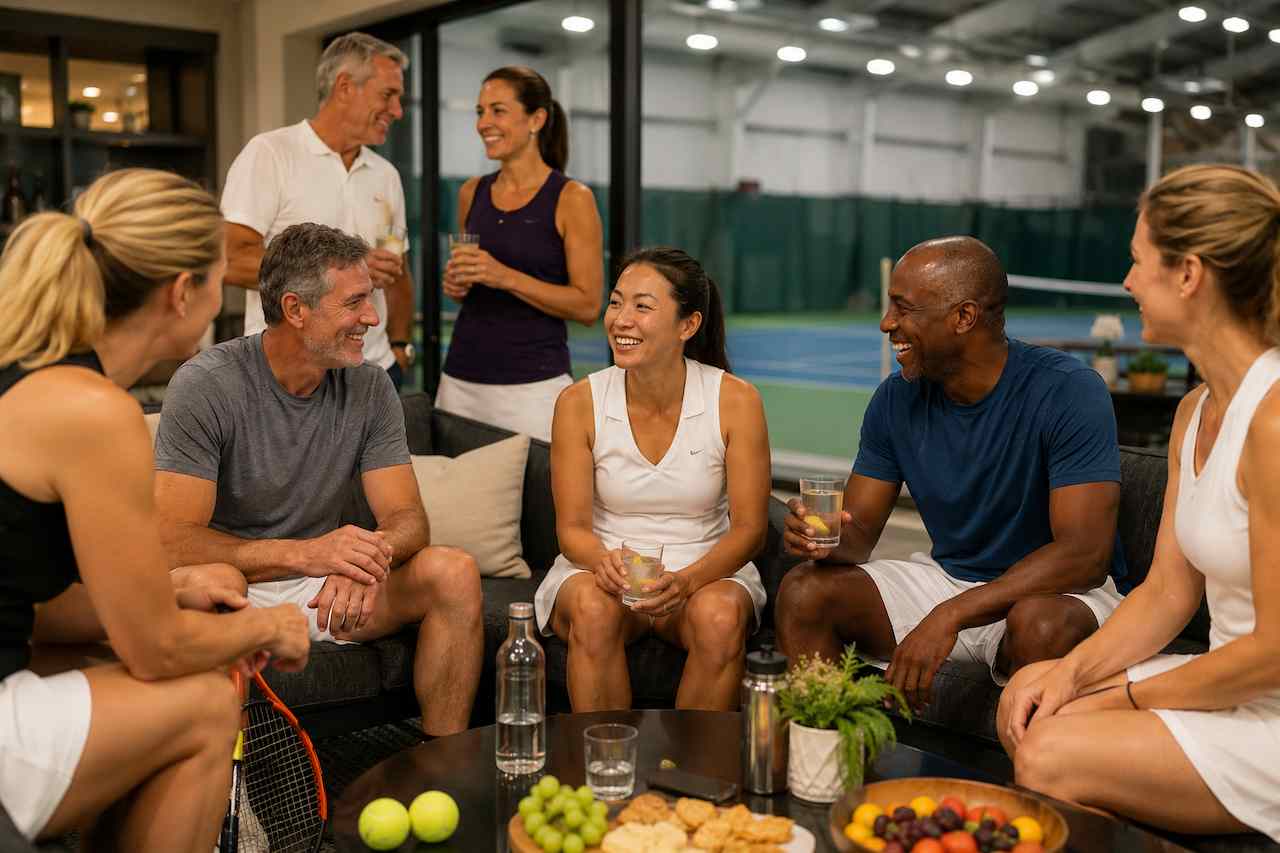
Tennis club social events take many different forms, and the variety is part of what makes them accessible to members with different personalities, schedules, and comfort levels with social situations.
Round-robin mixers are one of the most common formats at both tennis and pickleball clubs. Players rotate through partners and opponents across a set number of games, ensuring everyone interacts with a wide cross-section of the membership rather than staying within their usual group. These events are particularly effective at helping newer members integrate into the club community quickly, because the format removes the awkwardness of not knowing who to play with and replaces it with a structured, friendly competitive environment.
Club championships and seasonal tournaments create a different kind of social energy the shared experience of competition, the pre-match nerves, the post-match conversations, and the recognition of players who perform well throughout the season. Even members who do not compete themselves often attend to support others, and those moments of shared celebration build club identity in a way that no individual session on the court can replicate.
Social dinners, end-of-season gatherings, and themed club nights provide connection opportunities that are entirely off the court and accessible to members at every skill level. These events matter because they signal that the club values its members as whole people, not just as players, and that the community extends beyond the baseline.
How Social Events Accelerate Player Development
There is a direct and underappreciated connection between a strong club social culture and the rate at which individual players improve. This connection is not immediately obvious, but we observe it consistently across both clubs.
Players who feel genuinely connected to their club community practice more consistently. They show up to sessions they might otherwise skip because they are looking forward to seeing familiar faces as much as they are looking forward to hitting balls. They are more willing to ask questions, seek feedback, and push themselves in front of people they trust. They recover from poor performances faster because the social support around them is real rather than transactional.
Beyond individual motivation, social events create playing relationships that directly benefit match development. A member who meets a new hitting partner at a club mixer gains a consistent practice partner. A player who competes against someone at a club tournament learns their game and builds the kind of head-to-head familiarity that sharpens competitive awareness. These connections form organically through social events in a way that a posted sign-up sheet for hitting partners never achieves.
Our adult development programs at Village Glen are built around this understanding. Structured coaching is one part of the development equation. The social environment that surrounds it the relationships, the shared goals, the accountability of being part of a community is the other part that makes improvement sustainable over a full season rather than only during individual sessions.
The Role of Social Events in Welcoming New Members
The first few weeks of a new membership are the most critical period for whether a player stays engaged long term. A new member who attends sessions but never connects with other members, never feels recognized by the club community, and never finds their place in the social fabric of the club is far more likely to quietly disengage than one who is actively welcomed and integrated early.
Social events serve as the most effective onboarding tool a club has. A new member who attends a round-robin mixer in their first month meets more fellow members in two hours than they would in two months of standard session attendance. They learn names, establish faces, and begin building the familiarity that makes every subsequent visit to the club feel like returning somewhere they belong rather than arriving somewhere unfamiliar.
We prioritize a strategy of encouraging new members at both clubs to attend at least one social event within their first four weeks of joining. The feedback from members who do is consistently that it transformed their experience of the club entirely and made the membership feel immediately worthwhile in ways that court access alone would not have achieved as quickly.
Social Events That Build Cross-Sport Community
One of the distinctive advantages of a dual-sport club environment is the opportunity for tennis and pickleball communities to overlap and connect through shared social events. At a club that offers both sports, social events create bridges between two communities that might otherwise stay entirely separate.
A mixed club mixer that includes both tennis and pickleball players introduces members who share a love of racquet sports but may never have interacted on the court. A shared end-of-season celebration that recognizes achievements across both sports builds a unified club identity rather than two parallel ones. These moments of cross-sport connection matter because they broaden every member’s social network within the club and reinforce the sense that they are part of something larger than a single program or court allocation.
Before we cover how to make the most of these events as a member, here is what a strong club social calendar typically delivers across a full season:
- Regular round-robin mixer events that rotate players through partners and opponents across skill levels and both sports
- Seasonal club championships with recognition ceremonies that celebrate competitive achievement and bring the broader membership together
- Themed social evenings and end-of-season gatherings that provide connection opportunities entirely separate from court performance
- New member welcome events that integrate recent joiners into the club community quickly and intentionally
- Informal post-session social time that builds on the natural conversation that follows a good match or clinic
Each of these formats serves a different social function, and a club that runs a varied calendar across all of them builds a richer, more connected community than one that relies on a single event type.
A Real-World Example: How a Club Event Changed a Member’s Experience
We worked with a member at South Towns who had been part of the club for nearly a full season but was quietly considering not renewing. She enjoyed the coaching and the court time, but she felt disconnected from the broader club community and found it difficult to integrate socially because most of her sessions were at quieter times of the day when fewer members were around.
After attending a club mixer event for the first time initially with some reluctance she met three other members at a similar skill level and stage of life. Two of them became regular hitting partners within a month. The third became a doubles partner she competed with in the following season’s club tournament through our tournaments and events program.
She renewed her membership without any hesitation and has since become one of the more active social members of the club. The court time had always been good. One social event changed the entire context around it.
How to Make the Most of Club Social Events as a Member
Attending a social event is the first step, but getting full value from it requires a small amount of intentional effort that most members underestimate. Showing up is necessary but not sufficient on its own.
Introduce yourself to at least two people you have not previously spoken to at every event you attend. This sounds simple, and it is but it is the specific habit that separates members who build a strong club network quickly from those who attend events and leave without meaningfully expanding their social circle within the club.
Follow up after the event. If you played alongside someone in a mixer and enjoyed the game, suggest a hitting session the following week. If you met someone at a social dinner with a similar schedule and skill level, exchange contact details and make a plan. The social event creates the opportunity. The follow-up converts it into a genuine ongoing relationship.
Our match play sessions at South Towns and Village Glen provide a natural follow-up environment for connections made at social events, because they bring the same members together in a structured competitive setting that builds on the familiarity already established.
Conclusion
Tennis club social events are not peripheral to the club experience they are central to it. They accelerate player development by building motivation and accountability. They welcome new members in ways that court access alone cannot. They create the playing relationships and personal friendships that make a club membership genuinely valuable over the long term. At Village Glen and South Towns Tennis and Pickleball, we invest in our social culture because we know it is what transforms a club from a facility into a community.
Why Choose Us
At Village Glen and South Towns Tennis and Pickleball, we have built a club culture where every member regardless of skill level, age, or experience feels genuinely welcomed, connected, and valued both on and off the court.
- Two full-service club locations in Williamsville and Orchard Park, each with an active and welcoming member community across tennis and pickleball
- A varied social events calendar that includes mixers, club championships, seasonal gatherings, and new member welcome events throughout the year
- Programs that intentionally integrate social connection with competitive and coaching development for a complete club experience
- A dual-sport community where tennis and pickleball players share events, facilities, and friendships across both games
- Dedicated staff who prioritize member experience and ensure every new and existing member feels part of the Village Glen and South Towns community from day one
Frequently Asked Questions
Do I need to be a strong player to attend club social events?
Absolutely not. Club social events are designed to be inclusive across all skill levels, and the most effective formats such as round-robin mixers are specifically structured to rotate players through different partners and opponents so that skill level is never a barrier to participation. Social events are often the most accessible entry point into the broader club community for newer or less experienced players.
How often does Village Glen and South Towns run social events throughout the year?
Both clubs run social events across all seasons, with the frequency and format varying between a lighter indoor season calendar and a fuller outdoor season program. New member welcome events, seasonal mixers, and club championships are recurring fixtures throughout the year. We recommend checking the current events calendar at both clubs directly for up-to-date scheduling across all formats.
Can I attend social events as a guest before committing to a membership?
Certain open events and community mixers are accessible to non-members as an opportunity to experience the club environment before making a membership decision. The best way to find out which events are currently open to guests is to contact us directly, as availability varies depending on the format and current capacity at each club.
Are social events available for junior members as well as adults?
Yes. Both clubs run events and programs that serve junior members as well as adults, and certain seasonal events bring junior and adult members together within a shared club environment. Junior players benefit from the social dimension of club membership in the same way adults do building friendships, competitive relationships, and a sense of belonging that supports their long-term engagement with the sport.
What is the best way to find out about upcoming social events at Village Glen and South Towns?
The most reliable way to stay informed about upcoming events at both clubs is through direct communication with club staff and through the member communications that go out regularly across both locations. Following the clubs through their available contact channels ensures you receive advance notice of events with enough time to plan your attendance. We also recommend speaking with staff at either club directly if you are new and want guidance on which upcoming events are the best starting point for your first social experience at the club.