Most players have a general sense that they want to get better at tennis or pickleball. Far fewer have a clear picture of what better actually looks like for them specifically, how they will know when they have achieved it, and what they are doing differently today compared to six months ago. Without answers to those three questions, improvement becomes accidental rather than deliberate and accidental improvement has a very low ceiling.
We work with players at every level at Village Glen and South Towns Tennis and Pickleball in Western New York, and the ones who improve fastest are almost never the most naturally gifted. They are the ones who know exactly what they are working on, track whether it is getting better, and adjust their approach when it is not. This guide gives you the same framework we use with our players practical, structured, and immediately applicable regardless of your current level.
Why Most Players Stop Improving Without Realising It
Plateaus in tennis and pickleball are extremely common, and the frustrating part is that most players do not recognise them as plateaus until they have been stuck at the same level for months or even years. They are still playing regularly, still working hard in sessions, and still getting some enjoyment from the game but the needle on their actual performance has stopped moving.
The reason is almost always the same. Practice without measurement produces repetition, not improvement. A player who hits forehands for an hour three times per week is getting fitter and maintaining ball feel, but if nothing about those sessions is being evaluated success rate, contact point consistency, shot direction accuracy there is no feedback loop to drive genuine development. The body repeats what it already knows rather than building something new.
We always advise players who feel stuck to treat their development as a project with measurable outcomes rather than a hobby with no scoreboard. The moment you start tracking specific aspects of your game, patterns become visible that were previously invisible and visible patterns are fixable ones.
Step One: Define What Progress Looks Like for You
Before you can track progress, you need a clear definition of what progress means for your game at this specific point in your development. This sounds obvious, but the majority of players have never articulated it with any precision.
Progress for a beginner pickleball player means something entirely different from progress for an intermediate tennis player preparing for a club tournament. A beginner might define progress as landing 8 out of 10 serves in the correct service box. An intermediate player might define it as reducing double faults to fewer than three per set. A competitive doubles player might define it as winning more than 60 percent of points at the net across a full match.
The specificity is what matters. Vague goals like play better or be more consistent produce vague results because there is no clear threshold to work toward or measure against. Specific, numerical goals create a feedback loop that makes progress visible and motivating rather than ambiguous and discouraging.
Sit down before your next session and write one specific, measurable goal for each of the following three areas: a technical skill you are developing, a tactical habit you are building, and a physical quality you are working on. These three areas together cover the full picture of what competitive performance actually requires.
Step Two: Keep a Simple Practice Journal
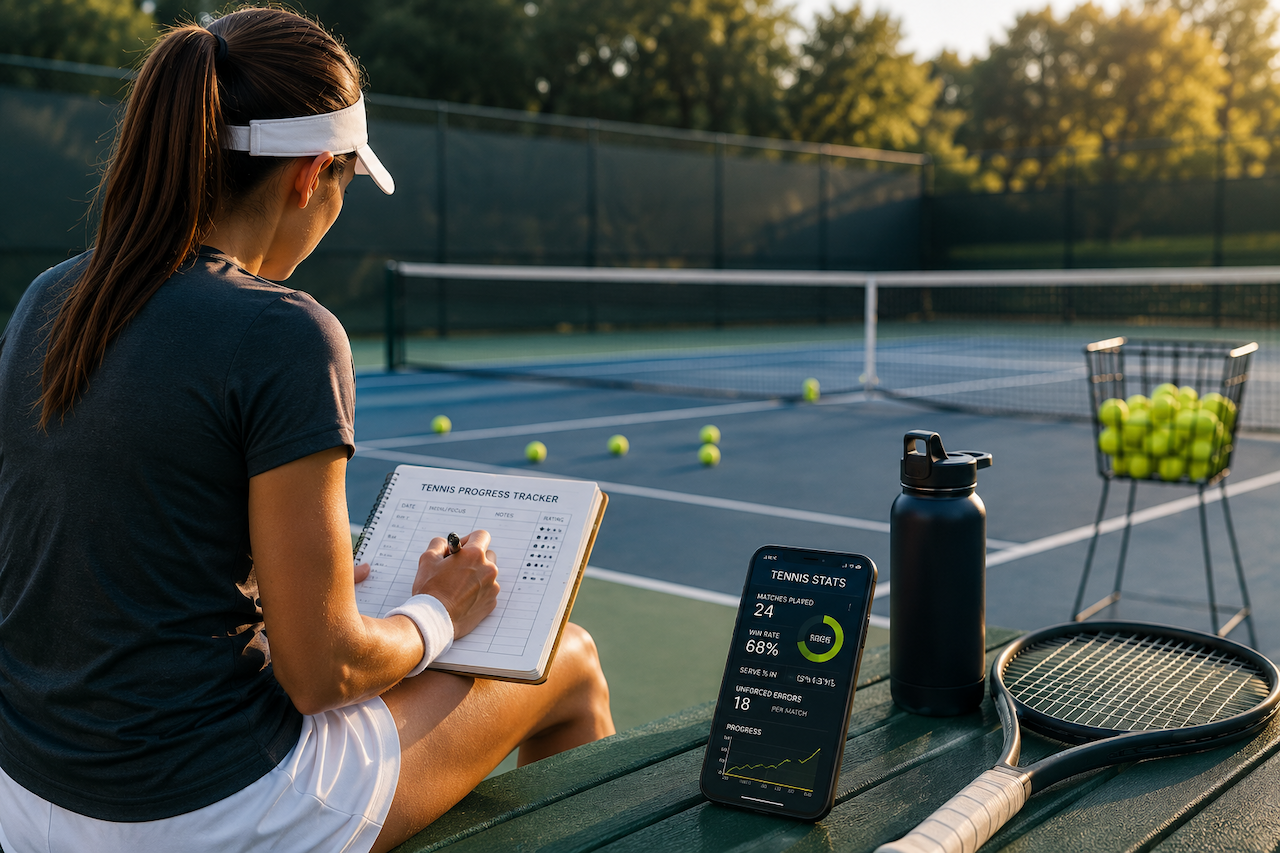
A practice journal does not need to be elaborate or time-consuming. The most effective version takes three to five minutes to complete after every session and captures four pieces of information consistently.
The first is what you worked on specifically during the session not just played tennis but drilled cross-court backhands with a focus on contact point in front of the body. The second is one thing that went well, stated specifically enough to be repeatable. The third is one thing that broke down, stated specifically enough to be addressable. The fourth is one adjustment to make or one drill to prioritize in the next session based on what you observed.
Over four to six weeks, this simple record produces something genuinely valuable a pattern of data about your game that no single session can reveal. You begin to see which errors are consistent across sessions and which are situational. You see which technical adjustments are holding and which are slipping back. You see whether your stated goal is getting closer or whether your current approach is not producing the movement you expected.
Players who combine journal-based self-tracking with regular sessions through our adult development programs at Village Glen consistently report that the combination produces faster and more durable improvement than either the coaching or the journaling produces in isolation because the journal gives structure to what the coaching reveals.
Step Three: Use Video to See What You Cannot Feel
One of the most significant limitations in self-directed improvement is that what a player feels during a swing and what is actually happening are rarely the same thing. A player who is convinced their ball toss is going straight up during the serve is often placing it 12 to 18 inches forward or to the side. A player who believes their follow-through is complete is frequently cutting it short under pressure without any awareness that it is happening.
Video solves this gap immediately and completely. Filming your own technique from the side and from behind during practice sessions even on a smartphone propped against a bag or fence gives you an external perspective that transforms your ability to self-correct. Watch the footage immediately after the session while the physical sensations are still fresh, and compare what you saw with what you felt. The discrepancy is almost always instructive.
Specific things to observe in your own video include the position of your toss at its peak relative to your contact point, the angle of your racquet or paddle face at the moment of contact, the completeness of your follow-through, and the position of your feet at the moment you make contact with the ball. Each of these variables is difficult to assess during live play and immediately obvious on video.
Step Four: Track Match Statistics to Identify Real Weaknesses
Practice statistics tell you how your technique is developing in a controlled environment. Match statistics tell you what is actually holding you back under pressure which is a different and often more honest picture.
Before we cover which statistics are most useful, here is a practical summary of the match data points that consistently reveal the most actionable information for developing players:
- First serve percentage per set a number below 50 percent signals either a technical issue with serve mechanics or a strategic issue with serve selection and risk management
- Double fault count per set more than three double faults per set consistently indicates second serve mechanics or mental pressure management that needs direct attention
- Unforced error count by shot type tracking which specific shot produces the most unforced errors identifies your weakest technical area faster than any amount of general observation
- Net points won versus net points lost a negative ratio here signals either poor net approach selection or volley mechanics that need development
- Break point conversion rate in competitive match formats a low conversion rate on break points typically reveals a specific pattern of decision-making under pressure that practice conditions never create
You do not need sophisticated software or a dedicated statistician to track these numbers. A small notepad kept courtside and filled in between sets is enough to build a dataset over four to six matches that reveals clear, specific patterns in your competitive performance.
Step Five: Build Regular Coaching Checkpoints Into Your Development
Self-tracking journals, video review, and match statistics is a powerful development tool, but it has one significant limitation. It can tell you that something is not working but not always why or what the correct fix is. That is where structured coaching checkpoints become essential rather than optional.
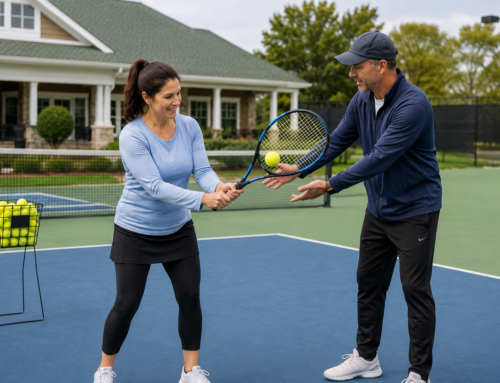
A coaching checkpoint is not an open-ended lesson where you work on whatever feels most pressing on the day. It is a structured review session where you bring your journal, your video footage, and your match statistics to a coach who assesses your actual progress against your stated goals and identifies whether your current approach is producing the development you are working toward.
We have seen firsthand how much faster players improve when they combine consistent self-tracking with regular coaching checkpoints typically every four to six weeks compared to players who attend lessons without any structured self-assessment between them. The coaching becomes more targeted, the feedback is more specific, and the player arrives at each session with a clear picture of what needs attention rather than starting from a blank slate every time.
Booking private lessons at South Towns on a scheduled four-to-six-week review cycle rather than on an ad-hoc basis is one of the most practical structural changes a developing player can make to the way they approach their improvement.
A Real-World Example: From Guessing to Measurable Growth
We worked with an intermediate pickleball player at Village Glen who had been playing for 18 months and was genuinely frustrated. He was attending open play three times per week, working hard in every session, and watching instructional content online regularly but his rating had not changed and his match results against familiar opponents were no better than they had been six months earlier.
When we sat down with him and reviewed his approach, the issue was clear. He had no specific goals, no record of what he was working on between sessions, and no objective data about what was actually failing in his matches. He was practicing hard but practicing blindly.
We introduced him to a simple journal process, had him film three open play sessions for self-review, and asked him to track his unforced error count by shot type across five matches. Within three weeks the pattern was unmistakable he was generating the majority of his unforced errors on his backhand drive when the ball was below net height, specifically because his paddle face was closing slightly at contact on that particular shot.
We addressed the mechanical issue through targeted drilling in our pickleball clinics at South Towns, and within six weeks his unforced error rate on that specific shot had dropped significantly. His rating improved at the next assessment and his match results against familiar opponents shifted noticeably within the same period. Nothing about his practice volume changed only the structure and the measurement around it.
How to Use Your Progress Data to Have Better Coaching Conversations
One of the most underused benefits of systematic progress tracking is the quality of coaching conversation it enables. A player who arrives at a lesson and says my game feels off gets a generic response because the problem is not specific enough to address precisely. A player who arrives and says my first serve percentage has dropped from 62 percent to 44 percent over the last four matches and I think it correlates with a change in my ball toss position gets a targeted, efficient response that addresses the actual problem directly.
Your journal entries, video clips, and match statistics are not just personal records they are the briefing documents for every coaching session you attend. Use them as such. Share your journal observations with your coach before the lesson begins. Show them the video footage of the specific shot you are struggling with. Bring your match statistics and ask them to help you interpret the patterns you are seeing.
This approach compresses the diagnostic portion of every coaching session from 15 to 20 minutes into two to three minutes and redirects that time toward actual correction and drilling. Over a full season of regular lessons, that time saving compounds into a significant additional volume of productive coaching work.
Our coaching staff across both clubs actively encourages players to bring their own observations and data into sessions. Visiting our club hub gives you access to additional resources and club information that supports your development tracking as a member of both clubs.
Conclusion
Tracking your progress in tennis and pickleball is not a complicated or time-consuming process. A clear goal, a simple practice journal, occasional video review, and a handful of match statistics are enough to transform the way you develop and the speed at which improvement becomes visible. The players who improve fastest are not the ones who practice the most they are the ones who practice with the most clarity about what they are working on and why. At Village Glen and South Towns Tennis and Pickleball, we are here to help you build that clarity and the coaching support to act on it.
Why Choose Us
At Village Glen and South Towns Tennis and Pickleball, we combine structured coaching, individualized feedback, and a development-focused club environment to help every player improve with clarity, consistency, and measurable results.
- Two full-service club locations in Williamsville and Orchard Park, with certified coaches who conduct structured progress reviews and individualized development planning
- Adult, junior, beginner, and competitive programs that incorporate goal-setting, feedback, and regular performance assessment throughout the full season
- A coaching approach that goes beyond general instruction to provide specific, data-informed corrections that target the actual root cause of each player’s limitations
- Clinic and match play sessions that provide the competitive repetition needed to test and consolidate technical improvements made in practice
- A supportive and performance-focused club community in Western New York where players at every level are actively encouraged and supported in their development goals
Frequently Asked Questions
How often should I review my progress to stay on track with my development?
A meaningful progress review every four to six weeks is the right frequency for most developing players. Reviewing too frequently after every session, for example does not allow enough time for a pattern to emerge from the data. Reviewing too infrequently means small problems compound into larger habits before they are identified and addressed.
What is the most important statistic to track in tennis matches?
Unforced error count by shot type is consistently the most actionable statistic for developing players because it directly identifies the specific technical weakness that is costing the most points in real match situations. First serve percentage is a close second because it reveals both technical and tactical issues simultaneously. Together, these two statistics give most recreational and intermediate players a clearer picture of their competitive weaknesses than any other data points available without professional tracking tools.
Do I need to hire a coach to track my progress effectively?
A coach is not required to begin tracking your progress effectively the journal, video, and match statistics approach in this guide can be implemented entirely independently and will produce useful data from the first week. However, a coach becomes essential when your self-tracking reveals a problem but you are uncertain how to fix it, which is the natural ceiling of self-directed development.
How long does it typically take to see measurable improvement when tracking progress deliberately?
Most players notice a measurable difference in a specific targeted skill within four to eight weeks of deliberate, structured practice with clear goals and consistent tracking. Broader improvement in overall match performance typically takes one full season of consistent tracking and coaching to become reliably visible against familiar opponents. The timeline depends heavily on the complexity of the change being made, the frequency of practice, and how consistently the improvement approach is applied between coaching sessions.
Can juniors use progress tracking in the same way as adult players?
Yes, with slight adjustments to the complexity of the tracking system. Junior players benefit most from simplified goal-setting one clear technical target per session rather than multiple tracked metrics and from video review with a coach or parent who can help interpret what they are seeing. As junior players develop both their game and their self-awareness, the tracking system can become progressively more detailed.