A well-run tennis or pickleball event leaves every participant energized, connected, and already looking forward to the next one. A poorly planned one leaves players frustrated, confused about the format, and unlikely to return. The difference between the two almost always comes down to preparation not budget, not facility size, and not the number of players involved.
We have organized and supported a wide range of events at Village Glen and South Towns Tennis and Pickleball in Western New York, from casual social mixers to structured competitive tournaments. Across all of them, the events that succeed share the same core habits of planning, communication, and on-the-day execution. This guide gives you those habits in a format you can apply immediately, regardless of the size or format of the event you are organizing.
Start With a Clear Event Purpose
Every successful tennis or pickleball event begins with a clear answer to one question: what is this event for? The answer shapes every decision that follows the format, the skill level groupings, the scheduling, the tone, and the way you communicate with participants before the day.
A social mixer designed to help club members meet new people has entirely different requirements from a competitive round-robin tournament designed to test skill and produce a clear winner. A charity event that prioritizes fun and accessibility for all levels has different format needs from an intermediate doubles ladder that rewards consistent performance across multiple weeks.
Getting clarity on purpose before making any other decision prevents the single most common event planning mistake we see building a format around logistical convenience rather than around what participants are actually there to experience. We always advise event organizers to write the purpose of their event in one sentence before booking a court or designing a bracket, because every decision that follows should be testable against that sentence.
Choose the Right Format for Your Audience
Format is the most important structural decision in hosting a tennis or pickleball event, and the wrong format for your audience is one of the fastest ways to undermine an otherwise well-organized day.
For social and community events where the priority is interaction and fun over competitive intensity, a round-robin format works best. Every player rotates through multiple partners and opponents, no one is eliminated early, and the emphasis stays on participation rather than results. This format is accessible to players at every level and naturally creates the social mixing that community events are designed to produce.
For competitive events where players are invested in results and standings, a structured draw format either single elimination, double elimination, or a group stage followed by knockout rounds provides the competitive stakes that motivated players are looking for. These formats require more pre-event planning and a clear communication of the bracket structure before the event begins, but they produce the sense of genuine competition that keeps experienced players engaged throughout the day.
Round-robin with a finals format is often the most practical choice for mid-sized events because it combines the accessibility and participation benefits of round-robin with the competitive conclusion that gives the event a clear and satisfying ending.
Plan Your Court Allocation and Scheduling Carefully
Court allocation and scheduling are the areas where the most preventable event-day problems occur. Underestimating the time needed per match, failing to account for warmup time, or assigning too many players to too few courts creates delays that compound throughout the day and frustrate participants who are standing around waiting when they expected to be playing.
Before confirming your event schedule, calculate the total match time required based on your format, the number of participants, and the number of courts available. Build a buffer of 10 to 15 minutes between each scheduled round to absorb the natural variation in how long individual matches take. Assign one person specifically to timekeeping and match progression on the day, so that schedule management does not fall to whoever is closest when a round ends.
For larger events, a staggered start across multiple courts rather than bringing all players onto the court simultaneously reduces the congestion and noise at the beginning of each round and makes the event feel more organized and controlled from the first match. Our tournaments and events program at Village Glen and South Towns can support event planning and court allocation for organizers who want professional guidance before finalizing their schedule.
Communicate Clearly With All Participants Before the Event
The most avoidable source of event-day confusion is inadequate pre-event communication. Players who arrive uncertain about the format, the schedule, the scoring system, the dress code, or what equipment to bring create unnecessary chaos that disrupts the event before the first ball is hit.
Send a clear, concise pre-event communication to all participants at least 48 hours before the event. This communication should cover every practical detail a participant needs to arrive prepared and confident. The following checklist covers what every pre-event message should include:
- Event start time and the time by which all participants should arrive for check-in and warmup
- Court location and any specific entry or parking instructions relevant to the facility
- Format explanation how the event is structured, how many matches each player will play, and how results will be recorded
- Scoring system whether you are using standard scoring, no-ad scoring, or a simplified tiebreak format specific to the event
- Equipment requirements whether participants need to bring their own balls, and any dress code or footwear requirements
- Contact details for the event organizer in case of last-minute questions or cancellations on the day
A well-written pre-event message reduces the number of questions you receive on the day by a significant margin and signals to participants that the event is professionally organized before they even arrive.
Prioritise Safety at Every Stage of the Event
Safety is not a box to check during event planning it is a continuous responsibility that spans the pre-event preparation, the on-day management, and the post-event review. We prioritize a strategy of addressing safety proactively rather than reactively, because most preventable injuries and incidents at tennis and pickleball events happen when safety planning is treated as secondary to logistics.
The physical environment is the first priority. Inspect all courts before the event begins for surface damage, standing water, debris, or net height irregularities that could cause slips, trips, or equipment failure during play. Ensure there is clear separation between active courts and spectator or waiting areas so that players on adjacent courts are not at risk from stray balls or players moving between courts unexpectedly.
Heat and hydration management matter significantly for outdoor events and for indoor events held during warmer periods. Ensure water is available at courtside for all participants throughout the event and communicate clearly in your pre-event message that players should arrive already hydrated. Schedule rest periods between rounds of sufficient length that players are not moving directly from one competitive match into the next without recovery time.
Have a clear first aid plan before the event begins. This means knowing the location of the nearest first aid kit, having at least one person present who is confident in basic first aid response, and having emergency contact information accessible. Our club rules and policies at Village Glen and South Towns set out the safety standards we apply across all events and are a useful reference point for any organizer planning an event at either facility.
A Real-World Example: Turning a Chaotic First Event Into a Smooth Second One
We worked with a group of club members at South Towns who organized an informal pickleball social tournament for the first time with approximately 20 participants. The concept was strong and the enthusiasm was genuine, but the event ran into several avoidable problems matches ran over time because no one was managing the schedule, three players arrived unsure of the format because the pre-event message had been sent too close to the day, and a minor surface issue on one court went unaddressed until a player slipped and the court had to be taken out of rotation mid-event.
Rather than being discouraged, the organizing group came back to us before their second event and we worked through the planning process with them systematically. They adopted a clear round-robin format with a defined match length, sent a detailed pre-event message five days in advance, assigned a dedicated timekeeper, and conducted a full court inspection one hour before participants arrived.
The second event ran without a single scheduling delay, received consistent positive feedback from participants, and has since become a regular fixture in the club calendar. The improvement came entirely from preparation, not from spending more money or finding a larger venue. Connecting with our team through our contact page before organizing your first event at either club gives you access to exactly the kind of planning support that made that second event a success.
On-the-Day Management That Keeps the Event Running Smoothly
The best event plans require equally good on-the-day execution. Even with perfect preparation, events develop unexpected situations a player cancels at short notice, a match goes significantly over time, or a scoring dispute requires a clear resolution process. Having a plan for each of these before the day begins prevents small disruptions from becoming significant problems.
Designate a clear event lead on the day one person whose sole responsibility is managing the event flow, resolving disputes, and making scheduling adjustments as needed. This person should not be playing in the event themselves, because the dual responsibility of competing and managing creates attention conflicts that tend to result in both being done poorly.
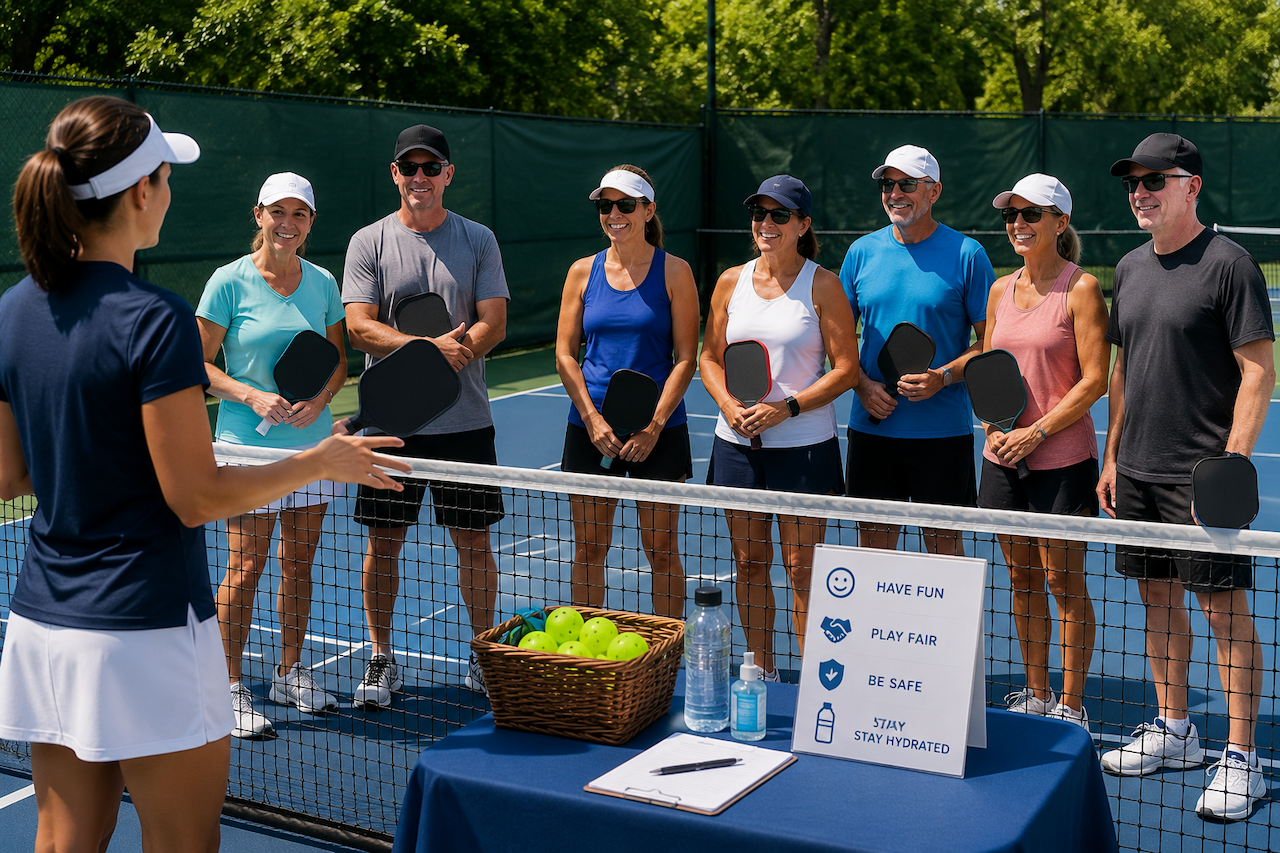
Brief all participants on the scoring system and dispute resolution process before the first match begins, not after a dispute has already occurred. A clear, fair, and pre-communicated resolution process such as replaying a disputed point rather than arguing about it prevents the disagreements that can sour the atmosphere of an otherwise well-run event.
Our adult development programs at Village Glen regularly run internal competitive formats that give players experience with structured event scoring and dispute management in a low-stakes setting useful preparation for players who want to move into organizing events of their own.
Post-Event Follow-Up That Builds Momentum for the Next One
The event does not end when the last match finishes. What happens in the 24 to 48 hours after the event directly determines whether participants stay engaged with the club community, whether they attend the next event, and whether they bring new players with them when they do.
Send a brief post-event message to all participants within 24 hours. Thank them for attending, share the results if the event was competitive, acknowledge any players who performed particularly well or contributed to the event in a meaningful way, and include a clear indication of when the next event will be scheduled. This message takes 15 minutes to write and produces a disproportionately large return in terms of participant satisfaction and retention.
Collect brief feedback from participants either through a short message reply or a simple two-question verbal check at the end of the event and use it to improve the next one. The most useful question to ask is simply: what was the best part of today, and what would you change for next time? The answers are almost always specific, honest, and directly actionable.
Conclusion
Hosting a tennis or pickleball event that participants genuinely enjoy and want to return to is entirely achievable with the right preparation. Clear purpose, the right format, careful scheduling, proactive safety management, and strong communication before and after the event are the five habits that separate events people talk about positively from events they quietly forget. At Village Glen and South Towns Tennis and Pickleball, we support event organizers at every stage of the planning process and welcome events of all sizes across both clubs.
Why Choose Us
At Village Glen and South Towns Tennis and Pickleball, we provide the facilities, the expertise, and the event support that make organizing a successful tennis or pickleball event straightforward and professionally delivered from start to finish.
- Two full-service club locations in Williamsville and Orchard Park, with dedicated court space, professional facilities, and experienced staff available to support events of all sizes
- An established tournaments and events program that gives organizers access to professional planning guidance, scheduling support, and on-the-day event management resources
- Courts maintained to a consistent standard across both tennis and pickleball formats, with full safety inspections completed before every event
- A welcoming and experienced club community in Western New York that supports social, competitive, and charity events throughout the full calendar year
- Direct access to certified coaches and club staff who can provide format advice, participant assessments, and technical support for any event hosted at either club
Frequently Asked Questions
How many courts do I need for a tennis or pickleball event with 20 participants?
For a round-robin format with 20 participants playing doubles, a minimum of four courts allows continuous play with adequate rotation time between rounds. For singles formats with the same number of participants, three courts can work with careful scheduling but four courts provides more comfortable pacing. The specific court requirement depends on your format, match length, and whether you are running simultaneous matches or staggered starts.
What is the simplest scoring format for a social tennis or pickleball event?
A no-ad short set format first to six games with a tiebreak at five all, or first to four games for shorter events is the most practical scoring system for social events because it keeps match lengths predictable and prevents any single match from dominating court time. For pickleball social events, rally scoring to 11 or 15 points with a win-by-two rule is the standard social format and keeps games moving at a pace that suits a rotating round-robin structure.
How far in advance should I start planning a tennis or pickleball event?
For a small social event with 10 to 20 participants, four to six weeks of planning time is adequate if the format is straightforward and the court booking is confirmed early. For a larger competitive event with 30 or more participants, draws to manage, and results to track, eight to twelve weeks allows sufficient time for participant registration, format planning, pre-event communication, and logistics preparation.
Can I host a charity or fundraising event at Village Glen or South Towns?
Yes. Both clubs welcome charity and community events and our team is happy to discuss the specific requirements of your event, including court availability, scheduling, and any additional support we can provide. We recommend reaching out to us as early as possible in your planning process so we can confirm availability and discuss how to make the event as successful as possible for both participants and the cause you are supporting.
What should I do if a player gets injured during an event I am organizing?
Stop play on the affected court immediately and ensure the injured player is comfortable and not at risk of further injury before doing anything else. Access the nearest first aid kit and apply basic first aid if you are trained to do so, or call for emergency services if the injury is serious. Do not resume play on any court until the situation is fully resolved and the affected player is being appropriately cared for.