Most players treat the warm-up as optional. They arrive at the court, hit a few casual forehands, and assume their body is ready to compete. It is not. A body that has not been properly prepared for the explosive lateral movement, rotational power, and rapid direction changes that tennis demands is both a performance liability and an injury risk from the very first point.
We see the consequences of skipped warm-ups regularly at Village Glen and South Towns Tennis and Pickleball in Western New York pulled muscles in the first set, inconsistent early-match performance, and unnecessary elbow and shoulder discomfort that compounds across a season. The five warm-up exercises in this guide take less than 15 minutes to complete and make a measurable difference to how your body and your game perform from the moment play begins.
Why a Proper Warm-Up Matters More Than Most Players Realise
A proper warm-up does three things simultaneously. It raises muscle temperature, which increases the elasticity of tendons and reduces injury risk during explosive movements. It activates the specific neuromuscular patterns used in tennis the split step, the lateral push-off, the rotational swing so the body is not learning these movements under match pressure for the first time. And it raises the heart rate gradually to a level that supports sustained competitive effort rather than shocking the cardiovascular system into immediate high output.
Players who warm up properly make cleaner contact earlier in the match, move more efficiently in the opening games, and carry significantly less injury risk across a full season of regular play. The 15 minutes invested before the match pays back across every set that follows.
Exercise 1: Light Cardio and Dynamic Movement
Duration: 3 minutes
Purpose: Raise heart rate, increase blood flow, prepare joints
Begin every pre-match warm-up with three minutes of light continuous movement before any ball is hit or any stretch is attempted. A brisk walk around the court perimeter, a slow jog along the baseline, or light jumping jacks any sustained movement that raises the heart rate gradually and increases blood flow to the muscles and joints being asked to perform.
This first phase is not about intensity. It is about transition moving the body from a resting state into a state of readiness that makes every subsequent warm-up exercise and every subsequent point more effective. Players who skip this phase and move directly into stretching or hitting are stretching cold muscles, which increases injury risk rather than reducing it.
Three minutes of light movement is the minimum effective dose. If you have more time, five minutes is better. The investment is small and the protective effect is immediate.
Exercise 2: Dynamic Stretching Sequence
Duration: 4 minutes
Purpose: Increase range of motion, activate key muscle groups
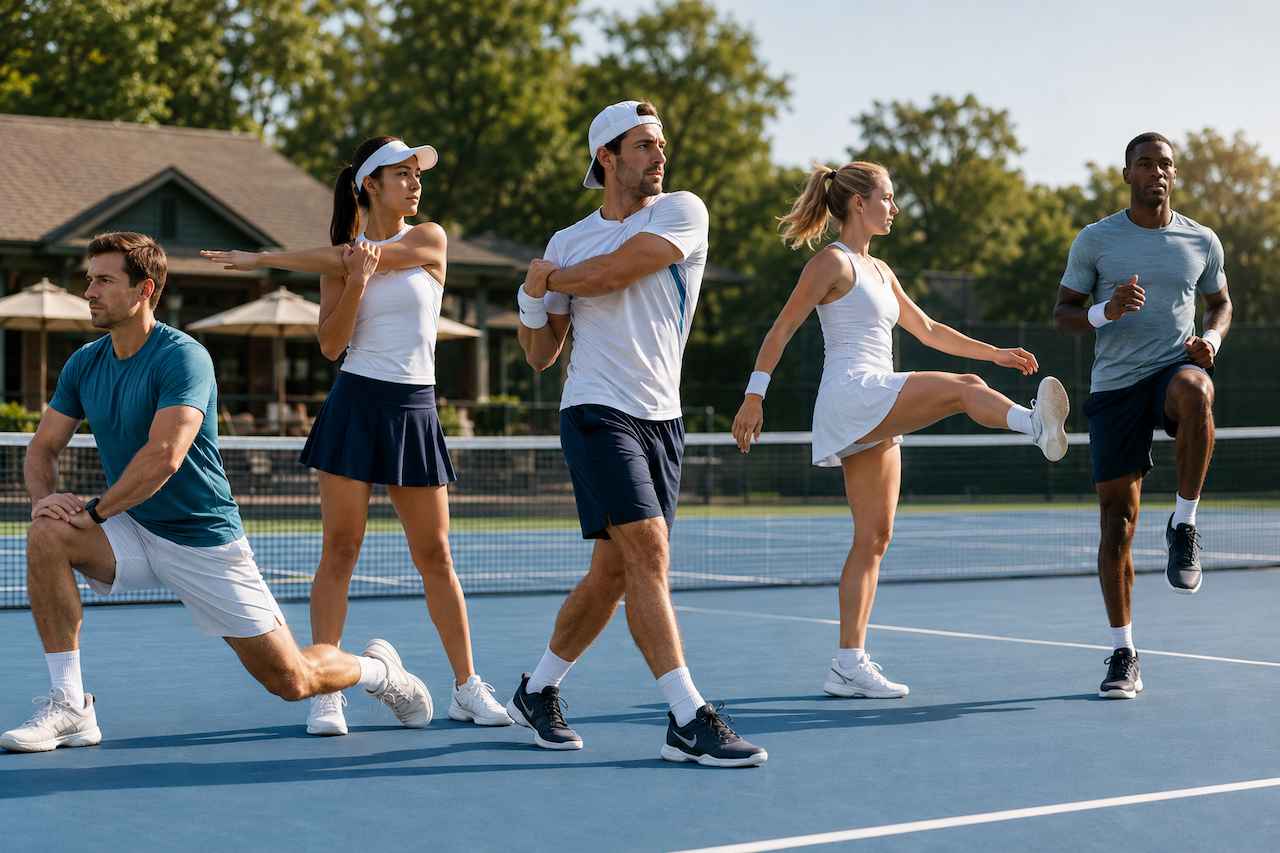
Dynamic stretching movement-based stretching performed through the full range of motion rather than held in a static position is the correct stretching approach before a tennis match. Static holds, where you hold a position for 20 to 30 seconds, are better saved for after the match when muscles are warm and the goal is flexibility rather than activation.
Work through this dynamic stretching sequence in order before every match:
- Leg swings forward and back stand beside the fence for support and swing each leg forward and back through its full range of motion, 10 repetitions per leg, to activate the hip flexors and hamstrings
- Lateral leg swings swing each leg across the body and out to the side, 10 repetitions per leg, to open the hip rotators and groin that are heavily loaded during lateral court movement
- Arm circles large, controlled circles forward and backward with both arms, 10 repetitions in each direction, to warm the shoulder joint and rotator cuff before serving and overhead play
- Trunk rotations stand with feet shoulder-width apart and rotate your upper body fully left and right with your arms extended, 10 repetitions per side, to activate the rotational core muscles that power every groundstroke and serve
- Ankle rolls rotate each ankle through its full range of motion in both directions, 10 repetitions per ankle, to prepare the joint for the lateral load and sudden direction changes of court movement
This sequence targets every major muscle group and joint used during a tennis match and takes under four minutes to complete at a controlled, deliberate pace.
Exercise 3: Split Step and Lateral Shuffle Activation
Duration: 2 minutes
Purpose: Activate court movement patterns, prepare footwork
The split step is the single most important footwork movement in tennis. It is the small, simultaneous two-footed hop that a player makes as their opponent contacts the ball, allowing them to push off quickly in any direction. Players who do not activate this movement pattern in the warm-up are often two or three games into a match before their footwork feels natural and responsive.
Spend two minutes activating the split step and lateral shuffle before hitting a single ball. Stand at the center mark on the baseline, perform a split step, then push off laterally to the right as if moving to a wide forehand, recover to center, split step again, and push off to the left as if moving to a wide backhand. Repeat this pattern continuously for two minutes at increasing speed.
This exercise directly replicates the most common movement pattern in a tennis match and ensures the fast-twitch muscle fibers responsible for explosive lateral speed are activated and ready before the competitive intensity of a real point demands them.
Exercise 4: Progressive Hitting Warm-Up
Duration: 5 minutes
Purpose: Establish ball feel, timing, and contact mechanics before full pace
The hitting portion of the warm-up should be progressive starting slow and short and building to full pace and full court over five minutes. Beginning the hitting warm-up at full intensity is one of the most common pre-match mistakes we observe, and it produces poor early contact, rushed mechanics, and a false sense that the game is not there when in reality the body simply has not been given time to find it.
Follow this progressive hitting sequence before every match:
- Minutes one and two: Stand at the service line and rally softly with your partner, focusing on clean contact and relaxed grip rather than pace or placement. This short-court rally establishes hand-eye coordination and ball feel at low intensity before full swing mechanics are added.
- Minutes three and four: Move to the baseline and continue rallying at 60 to 70 percent effort, now focusing on footwork and contact point in front of the body rather than shot direction or pace. The goal is establishing correct mechanics, not winning the warm-up.
- Minute five: Increase to 80 to 85 percent effort and begin directing balls to specific areas of the court cross-court, down the line, and to the center to activate shot selection and directional control before the match begins.
Finishing this sequence with six to eight serves at 70 percent pace gives the shoulder a structured warm-up specific to the serving motion before full serving intensity is applied in the match. This is one of the most effective single habits for reducing shoulder discomfort across a full season of regular play.
Our adult development programs at Village Glen build structured warm-up routines into every session so players develop this habit as a natural part of their court preparation rather than something they have to consciously remember before each match.
Exercise 5: Mental Activation and Game Plan Review
Duration: 2 minutes
Purpose: Focus the mind, establish competitive readiness
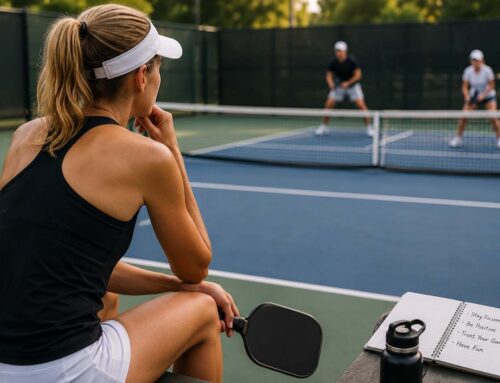
Physical preparation without mental preparation leaves half the warm-up incomplete. The final two minutes before a match begins should be spent in quiet, deliberate mental preparation not checking your phone, not chatting about unrelated topics, and not replaying the warm-up shots that did not feel right.
Use this two-minute window to answer three specific questions. What is your primary serve strategy for the opening games? Where are you directing your returns? What is the one technical cue contact in front, stay low through the dink, full follow-through that you want to execute on the first point of the match? Three clear, specific answers give your brain a competitive framework to work within from the first point rather than taking two or three games to settle into a rhythm.
Players who combine physical and mental activation before every match perform more consistently from the opening game and show significantly less of the slow start pattern that costs recreational players a disproportionate number of early break points and opening games.
A Real-World Example: How a Warm-Up Habit Changed a Season
We worked with a competitive recreational player at Village Glen who was consistently losing the opening set of matches he was technically capable of winning. His second and third sets were strong but the first set almost always slipped away before he felt fully in the game.
After reviewing his pre-match approach, the issue was clear. He was arriving at the court with three to four minutes to spare, hitting six to eight casual balls, and expecting to compete at full intensity from the first point. His body was not ready, his footwork was slow in the opening games, and his serve was inconsistent until the middle of the first set by which time the damage was already done.
We introduced the full 15-minute warm-up structure from this guide and worked on making it non-negotiable before every match through our private tennis lessons program. Within four weeks his first-set performance improved noticeably and the slow-start pattern that had cost him so many matches disappeared almost entirely. Nothing about his technique or fitness changed only his preparation.
How to Build These Exercises Into a Consistent Pre-Match Routine
Knowing the five exercises is the first step. Making them a non-negotiable pre-match habit is what produces the lasting benefit. The most effective approach is treating the warm-up as part of the match itself rather than a preliminary that can be shortened when time is tight.
Arrive at the court 20 minutes before your match start time 15 minutes for the warm-up sequence and five minutes for equipment preparation, court familiarisation, and settling into the competitive environment. Players who build this arrival habit consistently outperform players of equal technical ability who arrive with no preparation buffer.
If you are also playing pickleball alongside tennis, our pickleball clinics at South Towns apply the same warm-up principles to pickleball match preparation the dynamic stretching sequence and the progressive hitting approach transfer directly between both sports with minor modifications.
Conclusion
A proper warm-up before a tennis match is not a luxury reserved for professional players. It is a 15-minute investment that reduces injury risk, improves early-match performance, and builds the physical and mental readiness that recreational and competitive players at every level need to perform consistently from the first point. The five exercises in this guide cover every element of effective pre-match preparation. Make them a habit and the results show up in every set of every match you play. At Village Glen and South Towns Tennis and Pickleball, we are here to help you build that habit with the coaching and structured programs that make it stick.
Why Choose Us
At Village Glen and South Towns Tennis and Pickleball, we help every player develop the preparation habits, physical foundations, and technical consistency needed to perform at their best from the very first point of every match.
- Two full-service club locations in Williamsville and Orchard Park, with certified coaching staff who build structured warm-up routines into every program and lesson session
- Adult, junior, beginner, and competitive programs that incorporate pre-match preparation as a standard part of player development across both sports
- Private lessons that address both technical performance and the preparation habits that directly support match-day consistency
- Injury prevention coaching integrated into all programs, with warm-up structure forming a core part of the approach at both clubs
- A supportive and performance-focused player community in Western New York where good preparation habits are modeled and encouraged at every level
Frequently Asked Questions
How long before a tennis match should I start warming up?
Arriving at least 20 minutes before your match start time gives you enough space for a complete 15-minute warm-up and five minutes to settle into the competitive environment without rushing any part of the preparation. Players who arrive with less than 10 minutes to warm up should prioritize the dynamic stretching sequence and the progressive hitting warm-up over the light cardio phase, since these two elements produce the most direct performance benefit in the shortest available time.
Is static stretching bad before a tennis match?
Static stretching holding a position for 20 to 30 seconds is not harmful before a tennis match but it is not the most effective pre-match preparation approach. Research consistently shows that static stretching performed on cold muscles does not meaningfully reduce injury risk and can temporarily reduce the explosive muscle output needed for court movement. Dynamic stretching performed after light cardio is more effective before competition.
What if I only have five minutes to warm up before a match?
A five-minute warm-up is significantly better than no warm-up at all. With only five minutes available, prioritize the dynamic stretching sequence covering the legs, hips, shoulders, and trunk, followed by two to three minutes of progressive short-court hitting starting at the service line.
Should I warm up differently for singles versus doubles?
The core warm-up structure is the same for both formats, but the emphasis in the hitting phase differs slightly. For singles, emphasize baseline groundstroke pace and consistency during the progressive hitting phase. For doubles, add two to three minutes of net exchanges and volley work during the hitting phase to activate the reflexes and hand speed that net play demands.
Can I use this warm-up routine before pickleball matches as well?
Yes, with minor adjustments. The light cardio, dynamic stretching, and footwork activation exercises transfer directly to pickleball without modification. The progressive hitting phase should be adapted to start with soft dinking at the kitchen line rather than short-court groundstrokes, building progressively through drives and volleys before adding full-pace exchanges.